 How-to
How to Get Instant Property Valuations Without Guesswork
Last Updated: November 16, 2026
Quick Summary
To get instant property valuations, enter a full street address into an automated valuation model, confirm the auto-filled property facts, and correct any missing renovations or additions before reading the estimate range. The tool returns a free estimated value in seconds, but you should compare nearby sold homes and cross-check a second source.
- Start with a full street address, not a ZIP code, to pull the specific parcel record.
- Correct bedrooms, bathrooms, square footage, and unrecorded renovations before trusting the output.
- A tight estimate range signals good comparable data; a wide range signals uncertainty.
- Comparable sales should come from the previous 180 days and match on size, condition, and lot.
- Run the address through a second estimator and move to an agent valuation or appraisal if results diverge.
Table of Contents
- How to Get Instant Property Valuations Online in Minutes
- What a Free Home Value Estimator Can and Cannot Tell You
- Using a Home Value Estimator by Address: Step by Step
- How to Get Instant Property Valuations for Free Without Cutting Corners
- Automated Estimates, Agent Valuations, and Appraisals Compared
- A Practical Accuracy Checklist Before You Trust Any Estimate
- Run Your First Instant Valuation on The Jacques Team Platform
- Frequently Asked Questions
How to Get Instant Property Valuations Online in Minutes
Learning how to get instant property valuations takes about five minutes and costs nothing. You enter an address, confirm a few property details, and an automated model returns an estimated value with a range. Automated tools are useful, and they also have clear limits.
Automated valuation models, or AVMs, draw on millions of home records to produce an instant estimate, according to Chase's explanation of online home value estimators. That scale is the strength and the weakness.
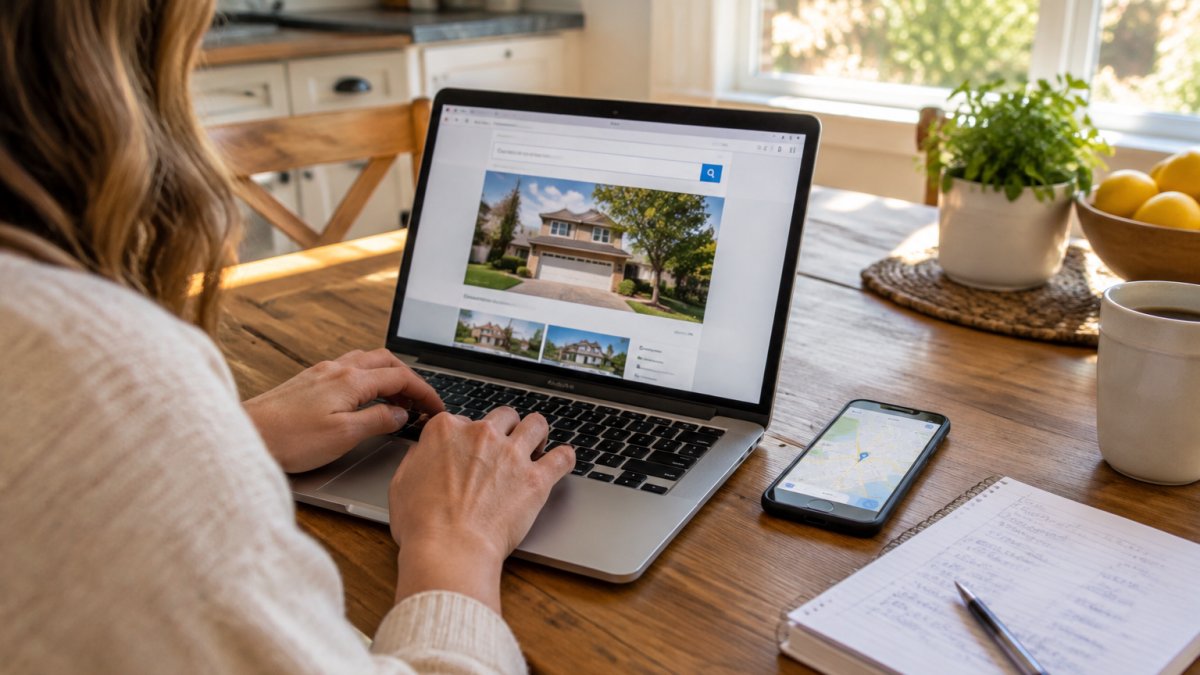
Entering a Property Address or ZIP Code to Start
Start with the address, not the ZIP code. A full street address pulls the specific parcel record, including bedrooms, bathrooms, square footage, and lot size. A ZIP code search returns a neighborhood-level average, which tells you about the area, not your house.
If you are still exploring an area rather than a single home, learn how to use interactive maps for home search before you commit to a specific address.
Updating Home Facts, Features, and Photos
The estimate is only as good as the property data behind it. Most estimators let you claim a property and correct the record. Do it.
- Confirm bedroom and bathroom counts
- Check reported square footage against your records
- Add renovations the public record missed
- Upload recent photos of the kitchen, baths, and exterior
- Note lot size and any additions
A finished basement or a new roof often sits in the county file years after the work was done. Correcting it can move an estimate meaningfully.
What a Free Home Value Estimator Can and Cannot Tell You
A free home value estimator gives you a fast, free baseline for a property's likely market value. It cannot replace a walkthrough, and it should never be the only number you rely on for a mortgage, refinance, or listing decision.
The limitations are structural. AVMs may miss property-specific nuances and current local market conditions in a way a professional appraisal or agent-led analysis does not, per Iconic Rate's review of valuation tool limitations. An estimate also reflects the data date, not today's negotiation.
What it does well: spotting rough price bands, screening listings, and flagging when an asking price looks out of line with nearby sales.
Using a Home Value Estimator by Address: Step by Step
A home value estimator by address follows a predictable path. Here is the sequence we recommend, with the check that matters at each stage.
| Step | Action | Time | What to Check |
|---|---|---|---|
| 1 | Enter the full street address | 1 min | Confirm the correct parcel, not a neighbor |
| 2 | Review auto-filled property facts | 2 min | Bedrooms, baths, square footage, lot size |
| 3 | Correct and update details | 5 min | Renovations, additions, condition notes |
| 4 | Read the estimate range | 1 min | The spread, not just the midpoint |
| 5 | Compare nearby sold homes | 5 min | Recency, similarity, price per square foot |
| 6 | Cross-check a second source | 5 min | Whether both estimates agree |
Reading the Estimate Range and Comparable Sales
The range matters more than the headline number. A tight range signals the model has good data; a wide range signals uncertainty, often because the property is unusual or sales are thin.
Comparable sales are the real test. A comparative market analysis typically relies on sales from the previous 180 days, per Realtors discussing standard CMA practice. Look for homes that match on square footage, bedroom count, lot size, and condition. If the comparables are six months old in a shifting market, discount them.
How to Get Instant Property Valuations for Free Without Cutting Corners
You can get instant property valuations for free and still do the work properly. Free does not mean careless. The difference between a useful estimate and a misleading one is the ten minutes you spend verifying inputs and comparables.
Three habits separate a careful check from a lazy one:
- Always correct the property facts before trusting the output
- Always read the range and the comparable sales behind it
- Always cross-check against a second estimator or an agent's read
Federal agencies, including the CFPB, FDIC, NCUA, and OCC, issued final guidance in 2024 on the risks of deficient residential valuations, per the interagency guidance on valuation reconsiderations. The message is simple: valuation quality is a regulated concern, not a formality.
Automated Estimates, Agent Valuations, and Appraisals Compared
The three valuation methods answer different questions, and choosing the wrong one wastes time or money. An automated estimate tells you roughly where a property sits. An agent valuation gives a pricing opinion for listing. An appraisal tells a lender what it is worth for financing.
Formal appraisal. A licensed or certified appraiser inspects the property in person, measures it, documents condition and upgrades, and applies the sales comparison approach (or cost or income approach where appropriate).
| Method | How it is produced | Typical turnaround | Who pays | Best for |
|---|---|---|---|---|
| Automated estimate (AVM) | Model on public records, listing, and sold data | Seconds | Free | Screening, rough price bands, flagging outliers |
| Agent valuation (CMA) | Agent-filtered comparable sales plus property review | 1-3 days | Usually free to a seller | Pricing a listing, negotiating strategy |
| Formal appraisal | Licensed appraiser inspection plus sales comparison analysis | 1-2 weeks | Usually the borrower | Mortgage, refinance, legal or estate purposes |
A comparative case study methodology is used to standardize information collection across valuation firms, ensuring consistency in residential assessments, according to IJRAR research on valuation methodology.
How to choose. If you are screening listings or want a rough band before you talk to anyone, start with the AVM.
Watch out: treating an AVM output as a substitute for an appraisal in a lending context can cause problems, because lenders typically require a formal appraisal.
A Practical Accuracy Checklist Before You Trust Any Estimate
Run this checklist before you act on any number. It takes minutes and can catch many bad estimates. Each item below explains what to verify and why it moves the number, so you know which failures are fixable and which mean you need a different valuation method.
- Address matches the correct parcel. Confirm the street number, unit, and parcel ID. A neighboring parcel or a similar street name can pull the wrong record entirely, and every downstream number will be wrong. If the tool shows a different square footage or bedroom count than you expect, stop and re-enter the address.
- Bedrooms, bathrooms, and square footage are accurate. These are the heaviest inputs in most models. A missing bedroom or a 200-square-foot discrepancy can shift the estimate by a meaningful margin. Check against your own records, a prior appraisal, or the county assessor's file.
- Lot size and any additions are recorded. Additions, finished basements, and accessory dwelling units are frequently missing from public records because they were permitted late or not at all. If the model does not see them, it will underprice the property.
- Recent renovations are reflected. A new kitchen or roof may sit in the county file years after the work was done. Most estimators let you claim the property and add updates; do it before you read the output.
- Estimate range is reasonably tight. A tight range signals the model has good comparable data; a wide range signals uncertainty, often because the property is unusual or sales are thin. If the spread is wide, treat the midpoint as a rough band, not a value.
- Comparable sales are within the last 180 days. A comparative market analysis typically relies on sales from the previous 180 days, per Realtors discussing standard CMA practice. Older comparables may reflect a different market, especially when rates or inventory have shifted.
- Comparables match on size, condition, and lot. A same-size home in disrepair is not a true comparable. Filter the sold list by square footage band, bedroom count, lot size, and condition before you trust the average.
- A second estimator broadly agrees. Run the address through a second AVM. If the two estimates diverge widely, the property is likely hard to value automatically, and you should move to an agent valuation or appraisal.
- Local market trend is factored in. Check whether the area is appreciating, flat, or declining. A model trained on older sales may lag a fast-moving market; an agent's read on current inventory and days on market fills that gap.
When a check fails. If the failure is a data error, wrong parcel, missing bedroom, unrecorded addition, correct the record and re-run the estimate. For those cases, see how to search land for sale and evaluate it before you buy.
Watch out: skipping the comparable-sales check because the headline number looks plausible. The midpoint can look reasonable while the underlying comparables are stale or mismatched, and that is exactly the error the checklist is designed to catch.
Run Your First Instant Valuation on The Jacques Team Platform
The fastest way to see how this works is to run one yourself. Our instant property valuation tool sits alongside a search platform updated every 15 minutes from the official Realtor® database.
You can draw custom search boundaries on the map, pull custom market reports for a neighborhood, and set daily email alerts for new listings, price changes, and sold data. Save a search and track how an area moves over weeks, not just today.
The gap between a rough estimate and a confident decision comes down to current data and a second opinion. The Jacques Team pairs instant property valuations with live listing data, interactive map search, and neighborhood market reports so you can check the number against what is actually selling.
Frequently Asked Questions
Can I get an instant house valuation without paying for an appraisal?
Yes. Automated valuation models pull from millions of home records to return an instant estimate for free, usually in seconds. These tools give you a baseline, not a certified number. For a mortgage, refinance, or a contested value, lenders typically require a licensed appraisal. Use the instant figure to set expectations, then confirm with comparable sales from the past 180 days or a local agent's comparative market analysis.
Are free online home value estimates accurate?
Accuracy varies by how well the model knows your property. Estimates are strongest in neighborhoods with many recent sales of similar homes and weakest where homes differ widely in size, condition, or lot. Automated models also cannot see renovations or interior condition unless you update those details. Treat any single estimate as a range, not a price, and cross-check it against nearby sold prices and current asking prices before making a decision.
How do I find my home value by address?
Enter your street address and ZIP code into a home value estimator, then review the property details the tool has on file. Correct the bedroom and bathroom count, square footage, lot size, and recent improvements. Add photos if the tool allows it. The estimate refreshes as you update those facts, and most tools also show recent comparable sales nearby so you can judge whether the number fits your block.
What information do I need to get an online home valuation?
At minimum, a property address. For a more useful estimate, gather your square footage, lot size, bedroom and bathroom count, year built, and a list of major renovations with rough dates. Recent sales prices for two or three similar homes nearby help you sanity-check the result. If you plan to sell, note anything that makes your property unusual, such as an addition, a large lot, or a view, because automated models often miss those details.