 How-to
How to Search Land for Sale and Evaluate It Before You Buy
Last Updated: November 13, 2026
Quick Summary
To search land for sale, run the same search on one MLS-fed brokerage site and one land-specific marketplace, then compare results. Set filters for county, an acreage range, property type, and a price ceiling with 20-30% headroom for development costs, and use the map view to draw boundaries. Save each search with daily alerts and track parcels on a sheet so new listings are compared against the same criteria.
- A five-step loop: define your use case, filter listings, save searches, check public records, then score each parcel.
- County and tax-sale sites list sheriff's sales and tax foreclosures but carry redemption periods and title risk.
- Treat every for-sale-by-owner parcel as unverified and ask for the parcel number, deed, and any survey.
- Find off-market land through county assessor and recorder records, GIS maps, and letters to out-of-state owners.
- Verify legal access, not just physical access: an easement must be recorded before you buy.
Table of Contents
- Build a Repeatable Workflow to Search Land for Sale
- How to Search for Land for Sale Online
- How to Search for Land for Sale by Owner
- How to Find Off-Market Land for Sale
- How to Evaluate Vacant Land Before You Make an Offer
- Compare Listings Consistently and Budget for Total Cost
- Start Your Land Search with Live Listing Data
- Frequently Asked Questions
Build a Repeatable Workflow to Search Land for Sale
Learning how to search land for sale works best as a routine, not a one-time browsing session. A practical approach is a five-step loop: define your use case, filter listings, save searches, check public records, then score each parcel against the same criteria.
Land is not like a house, and the paperwork matters more than the walk-through.
Below, we'll show you exactly how to run that loop, from online filters to county records to the due diligence checklist you should finish before any offer.
How to Search for Land for Sale Online
How to search for land for sale online starts with picking the right kind of platform, because the three main types surface different parcels and carry different data quality.
- MLS-fed brokerage and portal sites pull from the local multiple listing service, so listings are broker-verified and status changes (active, pending, sold) update quickly. Coverage is strong in areas with active broker participation and thinner in rural counties where few parcels are listed.
- National land-specific marketplaces aggregate rural, ranch, timber, and recreational tracts and often include broker contact details, acreage, and use classifications. They are the best starting point for farms, ranches, and hunting land, but listing freshness varies by source.
- County and tax-sale sites list sheriff's sales, tax foreclosures, and surplus property. These are not retail listings and carry their own rules, redemption periods, and title risk, but they are where some of the cheapest parcels appear.
A practical approach is to run the same search on one MLS-fed site and one land-specific marketplace, then compare results. Parcels that appear on both are usually actively marketed; parcels that appear on only one are worth a second look for stale or duplicate data.
Set Location, Acreage Range, and Property Type Filters
Start broad, then narrow. Search by county first, then city or nearby area. A parcel 20 minutes outside your target town may sit in a different county with different zoning, and that changes what you can build.
- Location: county, then city or unincorporated area. If a search returns few results, widen to adjacent counties or search by ZIP code and school district, which sometimes catch parcels the city filter misses.
- Acreage range: set a floor and ceiling, not a single number. A 5-20 acre band returns more usable results than typing "10 acres."
- Property type: vacant lot, farmland, ranch, timberland, waterfront property. Use the platform's use tags where available; a "recreational" tag often surfaces parcels that a "vacant land" filter hides.
- Price ceiling: leave 20-30% headroom for development costs.
Use the map view, not just the list view. Drawing a boundary around the area you actually want, a corridor along a highway, a watershed, a school district, can surface parcels that keyword searches miss, especially when the listing address is a rural route or a parcel number rather than a street address.
Read the Listing Data Critically
Listing photos flatter land. A wide-angle shot hides a steep slope, and a photo taken in summer hides seasonal flooding. Read the written details for the items that decide usability: acreage source (surveyed vs. estimated), road frontage vs. easement access, zoning district, utility notes, flood zone, and whether the parcel is part of a larger tract being split.
Watch out: a listing that shows a dirt road in the photos does not establish legal access. Confirm the access type in the written remarks and, for any parcel you get serious about, in the recorded documents.
Save Searches and Set Alerts for New Listings
A saved search with daily email alerts can help you keep up with new listings. Good parcels move fast, so having alerts running can help you see them sooner. Set one alert per search configuration, and let the inbox do the monitoring. Keep a simple tracking sheet, parcel number, county, acreage, asking price, price per acre, access type, and status, so a new alert can be compared against parcels you have already reviewed instead of starting from scratch each time.
How to Search for Land for Sale by Owner
Learning how to search for land for sale by owner means looking where agents don't list. For-sale-by-owner parcels show up on classified sites, local bulletin boards, farm and ranch networks, and social media groups.
Treat every FSBO parcel as unverified. Ask for the parcel number, the deed, and any survey the owner has. If the seller can't produce a parcel number, walk away until you can pull one from county records yourself.
How to Find Off-Market Land for Sale
How to find off-market land for sale comes down to three moves: public records, county maps, and direct outreach. Off-market parcels are the ones nobody has listed yet, and they're found by working backward from ownership records rather than forward from listings.
Public Records, County Maps, and Direct Outreach
County assessor and recorder offices hold the ownership record for every parcel in the jurisdiction. Most now offer online parcel maps and search tools.
From there, direct outreach does the rest. A short letter to an out-of-state owner of a vacant parcel often gets a reply, because many of those owners have been paying taxes on land they never use.
county property and land records guidance
How to Evaluate Vacant Land Before You Make an Offer
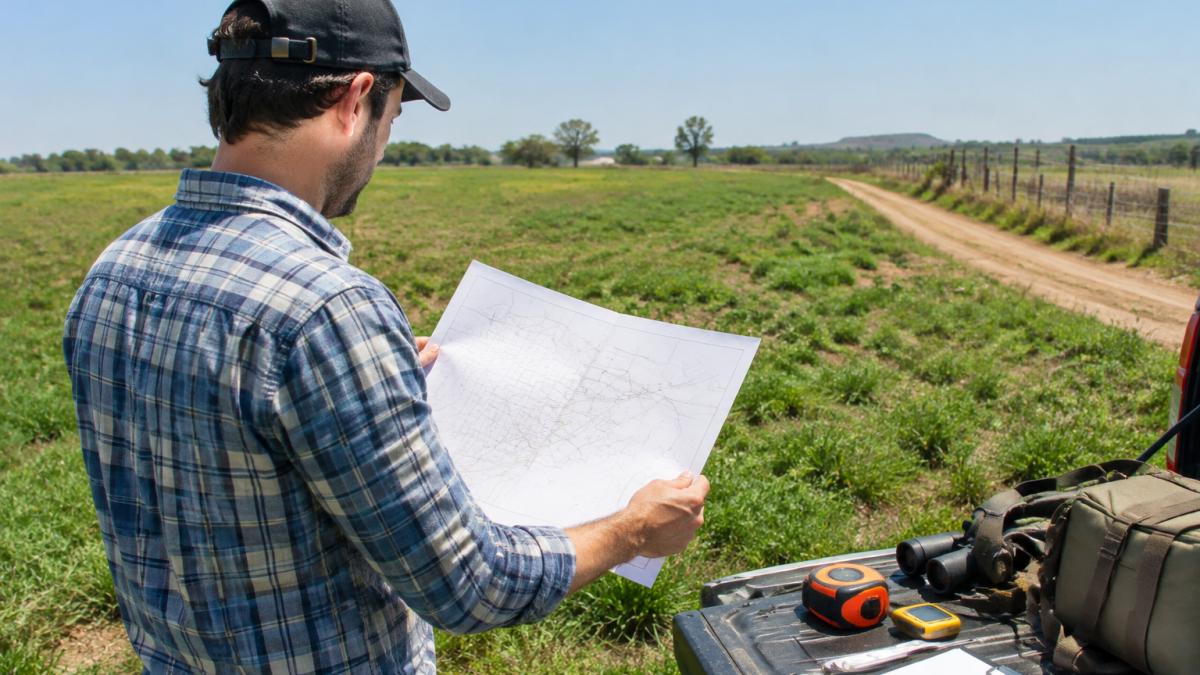
Evaluating vacant land means answering four questions before you make an offer: can I build on it, can I legally reach it, can I get utilities to it, and does zoning allow my intended use? A parcel that fails any one of these is a different, cheaper property than the listing suggests.
The fastest way to answer those questions is to work the public record before you tour the parcel.
Buildability, Access, Utilities, and Zoning Checks
Run this checklist on every parcel you're serious about:
- Zoning: confirm the parcel's zoning district and permitted uses with the county planning office. Ask specifically about minimum lot size, setbacks, and whether the district allows your intended use by right or only by conditional permit.
- Access: verify legal access, not just physical access. An easement must be recorded. Ask the county whether the parcel has frontage on a public road or relies on a private road or easement, and read the easement document for maintenance obligations and width.
- Utilities: check whether power, water, and sewer or septic are available at the lot line. Call the utility provider for power and the county environmental health office for septic feasibility; a perc test is often required before a building permit.
- Topography and drainage: review slope, flood zone status, and any wetland designation. FEMA flood maps and the county's wetland overlay are the starting point; a site visit after heavy rain tells you what the maps miss.
- Setbacks and minimum lot size: confirm the parcel can hold the structure you want after setbacks, and that the lot is not a substandard nonconforming parcel created by an old split.
Watch out: physical access is not legal access. A dirt road that reaches the parcel means nothing if no recorded easement gives you the right to use it. Buyers have purchased land they could only reach by trespassing.
Budget the Total Cost, Not Just the Asking Price
The asking price is the smallest number in a land purchase. Build a total-cost estimate before you make an offer, using the same line items for every parcel so the comparison is fair:
- Acquisition costs: purchase price, title search and title insurance, survey, closing fees, and any back taxes or liens that attach to the parcel.
- Site work: clearing, grading, driveway and culvert, and any required erosion-control measures.
- Utilities: well and pump, septic system and perc testing, and the utility company's line-extension charge if power is not already at the lot line.
- Permits and fees: building permit, septic permit, driveway permit, and any impact or utility-connection fees.
- Ongoing costs: property taxes, liability insurance on vacant land, fencing and upkeep, and the cost of holding the parcel while you decide what to build.
A parcel that looks cheap per acre can be the expensive one once line extension, site work, and a septic system are added. Price per acre is a starting comparison, not a decision metric.
county property and land records guidance
Compare Listings Consistently and Budget for Total Cost
Comparing land listings consistently means scoring each parcel against the same short list of criteria, not judging them one at a time. Use a simple weighted score so emotion doesn't pick the winner.
| Criterion | What to Check | Weight |
|---|---|---|
| Legal access | Recorded easement or frontage | High |
| Zoning fit | Permitted use matches your plan | High |
| Utilities | Power, water, septic feasibility | High |
| Buildability | Slope, flood zone, soil | Medium |
| Price per acre | Against nearby comparable sales | Medium |
| Distance to services | Drive time to town | Low |
Then budget beyond the purchase price. Land carries ongoing costs most buyers underestimate: property taxes, liability insurance, fencing and upkeep, plus the development costs of clearing, grading, well and septic, and utility connection.
Start Your Land Search with Live Listing Data
The search process only works if the data underneath it is current. A saved search built on stale listings wastes your time and hides the parcels worth pursuing.
That's the problem we built our platform to solve. The Jacques Team's platform is updated every 15 minutes directly from the official Realtor® database, covering land, lots, and foreclosure properties.
If you're evaluating a parcel, our instant property valuation tool can give you a starting point for comparison.
Land rewards the prepared buyer and punishes the impulsive one.
Frequently Asked Questions
What is the best way to search land for sale?
Start with a listing platform that pulls directly from the Realtor database, then filter by county, acreage range, and property type. Save the search so new parcels reach you by email. From there, verify each candidate against county records and a plat map before you visit. A tight filter set usually matters more than scrolling through volume.
Can you search for land for sale by owner without an agent?
Yes. For-sale-by-owner parcels appear on listing sites, local classifieds, and county record searches. When you search land this way, confirm the seller's ownership through the county assessor or recorder, ask for the parcel number, and request a current survey. By-owner deals often skip disclosure paperwork, so budget for your own title search and a professional inspection of access, utilities, and zoning before signing anything.
How do you find off-market land for sale?
Off-market parcels rarely appear on public listing sites. Pull county GIS and assessor records for vacant parcels in your target area, note owners who hold the land without a homestead exemption, and send direct mail or call. Absentee owners and long-held parcels are the most common sources. Track every contact in a spreadsheet so follow-up stays organized, and expect a slower timeline than a standard listing search.
What should you check before buying a vacant lot?
Confirm legal access, zoning and allowed use, utility availability, setbacks, flood zone status, and any easements or liens. Ask the county whether a building permit has ever been issued on the parcel, which reveals whether the land is buildable in practice. Get a survey and a title report before making an offer. Skipping these checks is the most common reason buyers end up with land they cannot develop.